You’re missing a tooth. It’s affecting your confidence, your ability to chew comfortably, and maybe even the way you speak. You’ve started exploring your options and narrowed it down to two choices: a dental bridge or a dental implant in Winter Springs, FL.
Both can restore your smile. Both can improve your quality of life. But they work very differently, and the right choice depends on your specific situation.
At New Smile Dentistry & Orthodontics in Winter Springs, FL, Dr. Firas Marouf and Dr. Melvin Benson help patients make this decision every day. They take time to understand your goals, evaluate your oral health, and recommend the option that fits you best.
Let’s break down the differences so you can feel confident about your choice.
What’s the Difference Between a Bridge and an Implant?
At a glance, both options “fill the gap.” But biologically and mechanically, they behave very differently.
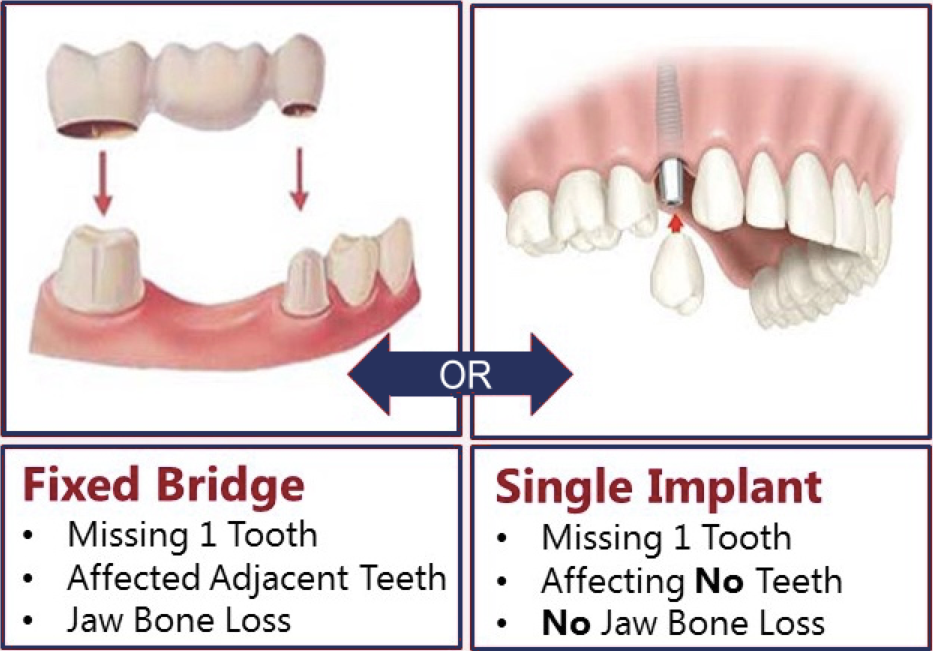
A dental bridge uses your neighboring teeth as support. The teeth on either side of the gap are prepared (shaped down) to hold crowns. The crowns anchor a false tooth (or teeth) in the middle that fills the space. The bridge is cemented into place and doesn’t come out.
A dental implant replaces the missing tooth root. A small titanium post is surgically placed into your jawbone. After it heals and fuses with the bone (a process called osseointegration), a custom-made crown is attached. The result is a stand-alone tooth replacement that doesn’t rely on neighboring teeth for support.
How They Compare: What Matters for Your Smile
Longevity and Lifespan
This is one of the biggest differences between the two options.
Implants are designed to last. With proper care, they can remain in place for 15 to 25 years or even longer. Clinical studies show a success rate above 95%, making them one of the most reliable tooth replacement solutions available. Some studies show implants achieving 98.5% survival at 5 years and 96.8% at 10 years. With proper care, the titanium post itself typically lasts your entire lifetime.
Bridges, on the other hand, have a shorter lifespan. They typically last 10 to 15 years before needing replacement. Studies show bridges average about 93.8% five-year survival, and that rate declines over time. Endodontic complications can develop in 5-10% of abutment teeth over a ten-year period.
The bottom line: If you want a permanent, long-lasting solution, implants are the clear winner.
Impact on Adjacent Teeth
Implants don’t affect your neighboring teeth at all. They stand independently, anchored in your jawbone. Your healthy teeth stay completely untouched. You can floss normally between all your teeth, keeping the cleaning routine you’ve used your whole life.
Bridges require removing 1.5 to 2mm of healthy tooth structure from your supporting teeth. This is permanent. Once that enamel is ground down, it’s gone forever. Studies show 15% of bridge-supporting teeth need root canal treatment within 10 years because of preparation damage. Prepared teeth also show an increased risk of decay, with biological complications affecting 10-15% of bridge supports.
Implants preserve your natural teeth. Bridges permanently alter them.
Bone Health and Facial Structure
Your jawbone needs stimulation to stay strong and healthy. When you chew on an implant, the titanium post transfers forces directly into your jawbone, just like a natural tooth root. This mechanical stimulation triggers your bone to maintain its density and volume.
Bridges can’t provide this stimulation. The area under the bridge continues to lose bone over time, creating an increasingly compromised site. Over the years, bone loss can change your face shape and make you look older. Implants maintain stable bone levels, with only 0.2mm loss in the first year and 0.1mm annually after that.
Implants preserve your facial structure. Bridges allow it to degrade.
Success Rate Comparison
Both options have strong success rates, but they’re not identical.
TABLE
When a Bridge Might Be a Better Fit
Implants aren’t right for everyone. In some situations, a bridge is the more practical choice. Your dentist might recommend a bridge if:
- The adjacent teeth already need crowns. If your neighboring teeth are heavily restored, cracked, or have had root canals, they can serve as logical abutments for a bridge.
- You have limited bone or other anatomic constraints. Severe bone loss can make implant placement risky or demand extensive grafting.
- You have medical concerns that make surgery risky. Patients with certain bleeding disorders, those on specific medications, or those with high surgical anxiety may be safer with a bridge.
- You need a quick solution. If you have a fractured front tooth and want a fixed solution in weeks rather than months, a bridge can restore your smile quickly.
- You have a limited life expectancy. For patients over 70 with limited life expectancy, a bridge’s shorter timeline may suit their needs better.
Why Patients in Winter Springs Choose Implants
Despite the higher upfront cost, many patients choose implants for their long-term advantages.
“A bridge usually means grinding down the healthy teeth on either side of the gap,” the team at New Smile Dentistry notes. “That’s permanent damage to teeth that didn’t have any problems. And dentures? They can shift around while you eat or talk. Lots of our patients tell us they hate that insecure feeling.”
Dr. Melvin Benson, a dentist who earned a Fellowship from the Academy of General Dentistry (a distinction held by only 6% of general dentists), has extensive training in implant surgery and bone grafting. He also treats the whole patient and believes in “informing before he performs,” so you always understand your options.
In Winter Springs, FL, residents choose implants for the freedom and confidence they provide. You can eat an apple, tell a joke, or yawn without worrying about anything slipping out of place.
Making the Right Choice for You
Choosing between a dental implant and a bridge is personal. It depends on your oral health, budget, timeline, and long-term goals.
The best place to start is a conversation. Dr. Marouf and Dr. Benson will evaluate your smile, discuss your options, and recommend the treatment that best fits you.
If you’re in Winter Springs, Casselberry, Orlando, or any surrounding community, we’d love to meet you. We’ll take a look, answer your questions, and give you honest advice about which option is right for you.
Ready to explore your options? Call New Smile Dentistry & Orthodontics at (689) 329-1817 or request an appointment online. Your confident smile is waiting.